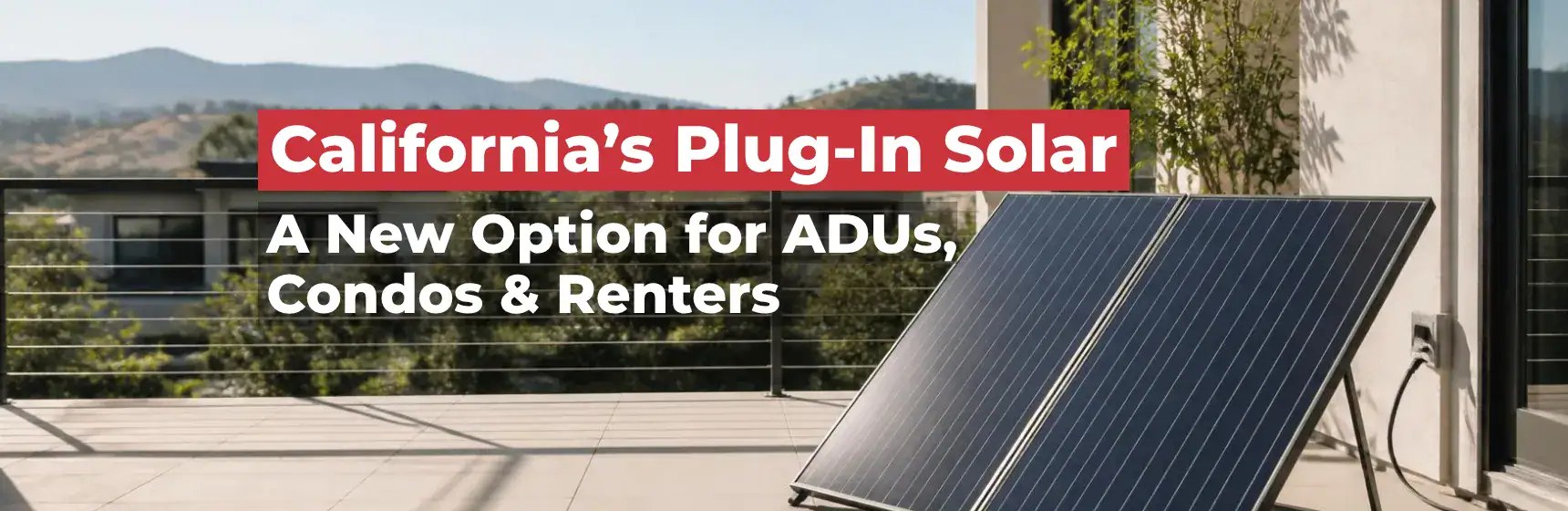
California Plug-In Solar: A Bay Area and Sonoma County Guide for Homes, ADUs and Renters
Starting January 1, 2027, Californians can plug a small, certified solar system into a standard outlet without going through their utility’s interconnection process.
Governor Newsom signed SB 868 on September 30, 2026. The law applies to homeowners, condo owners and renters, and you’ll see these systems called plug-in solar, plug-and-play solar or balcony solar.
I’m CJ Kerls, a Bay Area and Sonoma County mortgage lender, and I’ll walk through what the law allows, which utility you’ll deal with, and how plug-in solar compares with leased solar and Property Assessed Clean Energy (PACE) financing when you refinance or sell.
Key Takeaways
- Plug-in solar becomes legal in California on January 1, 2027, under SB 868, signed September 30, 2026.
- A qualifying system is capped at 1,200 watts per dwelling, plugs into an outlet, and must be certified as a plug-in solar system by Underwriters Laboratories (UL) or an equivalent testing lab.
- Your utility can’t charge a fee or require approval. It can ask you to fill out a simple online registration.
- The law covers PG&E and city-owned utilities, including Healdsburg, Palo Alto, Alameda and Santa Clara.
- A plug-in system shuts off during a power outage. It isn’t backup power, and it can’t run an accessory dwelling unit (ADU) that is still waiting for its utility hookup.
- The utility exemption expires January 1, 2030 unless the Legislature extends it.
- SB 868 doesn’t address homeowners associations (HOAs), leases or building permits, so those rules still apply.
- A plug-in system you own outright comes with no lease or PACE assessment for a lender to review when you refinance or sell.
What California’s Plug-In Solar Law Allows
SB 868 creates a category the law calls a portable solar generation device. To qualify, a system has to meet six conditions:
- Its combined output can’t exceed 1,200 watts AC per dwelling.
- It connects to and disconnects from the building’s wiring through a receptacle.
- It’s meant to offset electricity used on site.
- It meets the National Electrical Code and the California Electrical Code.
- It’s certified as a plug-in photovoltaic system by Underwriters Laboratories or an equivalent nationally recognized testing lab.
- It includes a certified feature that isolates it from the building’s wiring during a power outage, so it can’t send power back into the lines.
A system that meets those conditions is exempt from all utility interconnection requirements. Your utility can ask you to register it through a simple online form listing your address and the system’s make, model and size. It can’t make you wait for approval, and it can’t charge a fee for the device or for the electricity it feeds into your home.
That doesn’t mean any panel and inverter can be plugged into any outlet. The certification is what makes a system legal under this law. In late August, Canary Media reported that no product had yet earned certification under UL 3700, the standard for these systems, so check for a certified product before you buy.
The exemption has an end date. It’s repealed on January 1, 2030 unless the Legislature extends it. After that, a plug-in system would go back to needing utility sign-off.
Which Utility You’ll Deal With in the Bay Area and Sonoma County
For most of the Bay Area and Sonoma County, that’s PG&E. In August, PG&E said it supports plug-in solar for renters and apartment dwellers as long as the equipment is certified and meets safety standards.
If you buy your electricity from Sonoma Clean Power or another community choice provider, PG&E is still in the picture. Sonoma Clean Power says PG&E delivers the power, maintains the lines, handles outages and sends the bill. PG&E is the utility that handles your connection.
A few cities run their own electric utilities, and SB 868 covers them too:
- Healdsburg operates its own electric utility.
- Palo Alto has run a municipal electric system through City of Palo Alto Utilities since 1900.
- Alameda is served by Alameda Municipal Power, the city’s not-for-profit electric utility.
- Santa Clara runs its own utility, Silicon Valley Power.
In those four cities, the same rules apply: registration can be required, but approval and fees can’t.
Plug-In Solar for ADU Owners
ADUs are one of the most natural places for plug-in solar in Northern California. You’ve added a second living space and a second set of lights, appliances and heating and cooling. A small certified system can offset part of that use.
The order matters, though. Because a plug-in system shuts itself off when grid power is absent, it does nothing for an ADU that is still waiting to be connected. Power comes first.
That’s where a second new law comes in. SB 1196, signed September 27, 2026, was promoted as a way to speed up ADU utility hookups. It actually applies more broadly, to what the law calls small energization projects, and it directs the California Public Utilities Commission (CPUC) to set hookup timelines for PG&E and the state’s other investor-owned utilities by September 30, 2027. Many ADUs may qualify. An ADU that requires a utility distribution or service-line extension or upgrade under the CPUC’s Rules 15 or 16 would not, although a new electric meter by itself doesn’t disqualify a project. City-owned utilities like Healdsburg’s aren’t covered by SB 1196. I’ve written more about planning for the hookup.
Two questions the law leaves open are worth asking your utility before you buy:
- The meter question. If the ADU shares the main house’s meter, a plug-in system offsets use on that one meter, not “the ADU’s bill.”
- The cap question. SB 868 caps output at 1,200 watts per dwelling and doesn’t say how that applies to an ADU on a shared meter.
Condos and Renters
Rooftop solar usually isn’t an option if you don’t control the roof, and that’s where plug-in solar opens a door. A condo owner may have a balcony, patio or other exclusive-use area that works. A renter can take the system along when they move instead of leaving a permanent improvement on someone else’s property.
SB 868 deals with your utility, not your HOA or your lease. Covenants, conditions and restrictions (CC&Rs), building rules and lease terms still apply. If balcony solar matters to you when you’re buying a condo, treat it like any other HOA question: ask before you buy, and get the answer in writing. HOA rules come up in condo financing for other reasons too, which I cover in my San Francisco condo financing guide.
Plug-In Solar vs. Rooftop Solar
The two solve different problems. A rooftop system is a permanent improvement sized to cover much more of a home’s use, and it goes through permits and utility interconnection. A plug-in system is small, portable and skips interconnection.
For a single-family homeowner with high electricity use and a good roof, rooftop solar may still make more sense. For an ADU, a condo, an apartment, or anyone not ready for a rooftop project, plug-in solar is now an option worth looking at.
Leased Solar, PACE and Plug-In Solar When You Refinance or Sell
This is where a mortgage lender’s view helps, because how solar is paid for shows up in underwriting.
Leased solar and power purchase agreements. Under Fannie Mae’s Selling Guide, the monthly lease payment generally counts in your debt-to-income ratio. There’s an exception for certain agreements with a fixed energy delivery and a production guarantee. The panels’ value can’t be included in the appraised value, and the agreement has to meet specific terms on removal, damage and insurance. All of that is paperwork an underwriter has to review, and a buyer may have to take over the contract.
PACE financing. PACE loans for energy improvements are repaid through the property tax bill. Fannie Mae won’t buy a mortgage on a property with an outstanding PACE loan that has priority over the first mortgage. In practice, that usually means paying the PACE balance off when you refinance or sell.
Plug-in solar. A system you bought outright and can unplug carries no lease, no power purchase agreement and no PACE assessment. When you refinance, there’s nothing for an underwriter to review. When you sell, you take it with you.
If you’re weighing solar now and expect to refinance or sell in the next few years, that difference is worth factoring in.
Frequently Asked Questions
Is plug-in solar legal in California?
Yes, starting January 1, 2027. Governor Newsom signed SB 868 on September 30, 2026. It allows certified plug-in solar systems up to 1,200 watts per dwelling to connect through a standard outlet without going through the utility interconnection process. The exemption runs until January 1, 2030 unless the Legislature extends it.
Do I need PG&E’s permission to use plug-in solar?
No. Starting January 1, 2027, PG&E can’t require approval or charge a fee for a qualifying system. It can ask you to register through a simple online form listing your address and the system’s make, model and size. The same rule applies to city-owned utilities in Healdsburg, Palo Alto, Alameda and Santa Clara. If you buy power from Sonoma Clean Power or another community choice provider, PG&E still delivers it and handles your connection.
Can my HOA or landlord stop me from using balcony solar?
SB 868 doesn’t say. The law deals with your utility, not your HOA or your lease, so CC&Rs, building rules and lease terms still apply. If you’re buying a condo and want balcony solar, ask the HOA before you buy and get the answer in writing.
Do I need a permit or an electrician for plug-in solar?
SB 868 doesn’t require either, but it doesn’t override local rules. The law exempts qualifying systems from utility interconnection requirements and says nothing about building permits. Check with your city or county building department, and if you’re unsure whether an outlet and circuit can handle the system, ask an electrician.
Will plug-in solar keep my power on during an outage?
No. The law requires a certified feature that disconnects the system from your home’s wiring during a power outage, so it stops producing power when the grid goes down. It isn’t a backup power source.
Can I use plug-in solar in a new ADU?
Yes, once the ADU has power. A plug-in system connects through a standard outlet, and California’s law requires it to cut itself off from the building’s wiring when grid power is out, so it can’t power an ADU that is still waiting for its utility connection. Get the hookup first. A separate law, SB 1196, directs the CPUC to set hookup timelines for PG&E and the state’s other investor-owned utilities by September 30, 2027, for qualifying small energization projects. Many ADUs may qualify, but a project that requires a utility distribution or service-line extension or upgrade would not. City-owned utilities in Healdsburg, Palo Alto, Alameda and Santa Clara aren’t covered by it. Once the ADU is connected, a certified system can offset part of its electricity use. SB 868 caps output at 1,200 watts per dwelling and doesn’t say how that applies to an ADU sharing the main house’s meter, so ask your utility.
The Bottom Line
Plug-in solar won’t replace a rooftop system, and it won’t change the economics of owning a home in the Bay Area or Sonoma County. It does give renters, condo owners and ADU owners a way into solar that didn’t legally exist before, with no utility approval and no fee.
If you’re building an ADU, get the hookup sorted first, then look at plug-in solar. If you’re planning a refinance or sale, a system you own outright keeps the file simple. And if a bigger project is on the table, like an ADU or a renovation, that’s where the financing conversation starts. Call or email me and we’ll talk it through.
Sources
- California Legislative Information, SB 868, Electricity: portable solar generation devices, Chapter 985, Statutes of 2026, approved September 30, 2026.
- California Legislative Information, SB 1196, Small energization projects: electrical service connections, Chapter 684, Statutes of 2026, approved September 27, 2026.
- PG&E, Does PG&E Support Plug-In Solar?, August 11, 2026.
- Sonoma Clean Power, Frequently Asked Questions, PG&E’s role for Sonoma Clean Power customers.
- City of Healdsburg, Electric, Water & Wastewater Department, city-owned electric utility.
- City of Palo Alto, About CPAU, City of Palo Alto Utilities.
- City of Alameda, Alameda Municipal Power, the city’s municipal electric utility.
- City of Santa Clara, Energy and Electrification, Silicon Valley Power.
- Fannie Mae, Selling Guide B2-3-04, Special Property Eligibility Considerations, properties with leased solar panels or power purchase agreements.
- Fannie Mae, Selling Guide B5-3.4-01, Property Assessed Clean Energy Loans.
- Canary Media, California Legislature passes balcony solar bill, UL 3700 certification status.
Questions about your situation?
Call or email CJ directly. No pressure, just a real conversation about your options.
CJ Kerls NMLS #243438 · Rate NMLS #2611 · CA DRE #01320626. Licensed in 29 states. This content is for informational purposes only and does not constitute legal, tax, or financial advice, nor a commitment to lend. Loan approval is subject to credit and underwriting review. Not all applicants will qualify. Consult a qualified professional. Equal Housing Lender.